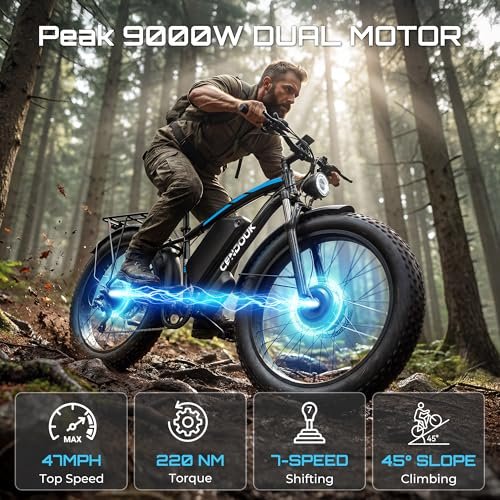
Two peak 4500W brushless hub motors combine for 220 N·m of torque — a verified 230 lb rider hit 45 mph on flat ground while pulling a trailer.
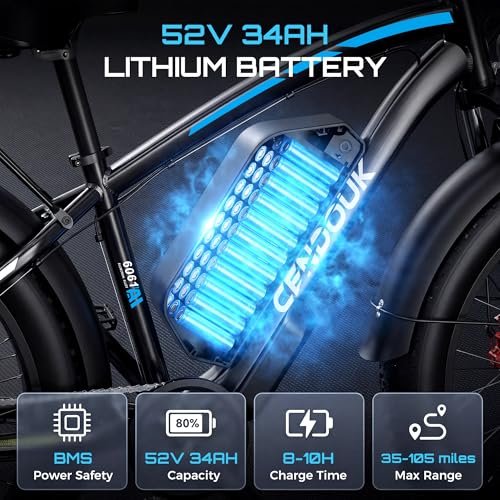
Switch from dual motor (30–35 miles pure electric) to PAS mode and the same 1,768Wh battery stretches to 105 miles — measurable difference, not a marketing claim.
24" × 4.0" fat tires, an IP67-rated removable battery, lockable front fork, and 4-piston hydraulic disc brakes with 180mm rotors handle terrain that stops lighter bikes cold.
Ships 90% pre-assembled — front wheel, handlebars, pedals, and seat are all that remain — with a step-by-step video guide, 12-month warranty, and 24/7 Amazon messaging support.
Both E2 PRO variants run the same dual-motor platform — peak 9000W output, 220 N·m torque, 52V 34Ah battery, 24" × 4.0" fat tires — in two colorways with one key difference worth knowing before you choose: the Green listing carries an explicit 330 lb maximum load rating, while the Black/Blue variant holds a 5.0-star rating across 11 reviews and ships with an additional rear bag in the kit. Same bike, different details that matter depending on what you're prioritizing.
The Black/Blue E2 PRO holds a 5.0-star rating across 11 verified reviews and ships with the most complete accessory kit in the lineup — cargo rack, rear bag, fenders, rechargeable phone holder, installation tools, and keys included. PAS range is cited at 105 miles; dual motor pure electric range runs 30–35 miles on the 1,768Wh battery.
Highest-rated E2 PRO variant with the most complete out-of-box kit — best choice for buyers who want maximum reviewer confidence and don't need an explicit load rating callout.
See on Amazon
The Green E2 PRO explicitly calls out a 330 lb maximum load rating and a 6061 aluminum alloy frame — specs that matter to heavier riders and buyers evaluating structural durability. The terrain designation covers mountain and unpaved trails specifically. PAS range is cited at 100 miles; dual motor pure electric range runs 30 miles on the 1,768Wh battery. Rear bag is not included in the kit.
The only E2 PRO variant with an explicit 330 lb max load rating — the right call for heavier riders who need confirmed weight capacity before committing.
See on AmazonDiscover the full product lineup with current selection on Amazon.
All products on AmazonThe E2 PRO has six riding modes, and the one you choose determines everything — top speed, range, terrain capability, and how hard the battery works. Most buyers focus on the peak 9000W headline and miss the more useful question: which mode will I actually use day to day, and what does that get me?
Both brushless hub motors run simultaneously, delivering the full combined output and the bike's peak 220 N·m of torque. This is the mode that climbs 45-degree grades without slowing, accelerates fastest from a stop, and tops out at up to 47 mph on flat terrain. It's also the most demanding on the battery — plan on 30–35 miles of pure electric range before you need a charge. Use this for trail climbing, heavy loads, or when you want maximum acceleration.
Power routes to the rear hub only. You lose some launch torque, but real-world range climbs to 40–45 miles — a meaningful difference if you're covering a daily commute or an extended trail loop. Top speed stays usable. For most riders doing mixed terrain or moderate commuting, this is the everyday default.
PAS is where the 105-mile range figure comes from. The cadence sensor detects your pedaling and supplies motor assistance at one of five configurable levels — the motor helps rather than replaces your effort. Range extends dramatically because the battery isn't doing all the work.
One thing worth saying plainly: the 105-mile figure requires you to actually pedal. It's not a "set the throttle and forget it" number. Riders who engage PAS at level 2 or 3 on a flat commute will realistically see 80–100 miles. PAS at level 5 on a steep grade is closer to single-motor territory in terms of battery draw.
The motor assists at a low walking pace — useful for pushing an 80-lb bike up a ramp, through a parking garage, or along a narrow trail section where riding isn't practical. It's a small feature, but you'll be glad it exists the first time you need it.
Locks the throttle at your current speed without requiring you to hold it. Useful on long flat stretches — trails, rural roads, open terrain — where you want to reduce hand fatigue without constantly monitoring your throttle position.
Motor assist is off. You're riding the E2 PRO as a conventional bicycle with seven gears. At approximately 80 lbs, this is genuinely hard work — Manual mode exists as a fallback if the battery runs out, not as a preferred riding style. That said, the 7-speed gear shifter gives you useful range for pedaling on flat ground.
| Mode | Estimated Range | Best Used For |
|---|---|---|
| Dual Motor | 30–35 miles | Maximum torque, steep climbs, fast acceleration, heavy loads |
| Single Motor | 40–45 miles | Daily commuting, moderate terrain, extended rides |
| PAS (Level 1–3) | 80–105 miles | Long-distance commuting, mixed rider and motor effort |
| Walk | N/A | Maneuvering the bike on foot in tight spaces |
| Cruise | Varies by base mode | Sustained flat-terrain riding with reduced hand fatigue |
| Manual | Human-powered only | Emergency fallback when battery is depleted |
Mode switching happens on the LCD panel — a button press moves you between them in under two seconds. There's no mechanical adjustment required. The 3.5" display shows your current mode, speed, battery percentage, and mileage in real time, so you always know what state the bike is in.
The 105-mile range and 47 mph top speed are real figures — but they don't apply at the same time, and they don't apply under all conditions. Here's what the numbers actually mean and when you'll see them.
The 9000W figure represents the surge output the two motors produce at maximum demand — during heavy acceleration, steep climbing, or dual-motor full-throttle operation. Continuous wattage during normal riding is lower; the peak number is a ceiling, not a floor. Running both motors at sustained peak draw would overheat any motor system and drain the 1,768Wh battery in well under 30 miles. The BMS and motor controllers manage this automatically, modulating output to protect hardware during extended hard use.
Think of it the way you'd think about a car's horsepower rating — the engine can produce that number, but you're not running at redline the whole drive.
The listing states "up to 47 mph depending on battery level, rider weight, and terrain" — and those qualifiers matter more than the headline. One verified buyer at 230 lbs reported 45 mph on flat ground. That's a real data point, not a lab condition. But the same rider on a 15% uphill grade, at 70% battery, will see a materially different number. The variables are:
The three range figures that appear in the listing represent three genuinely different riding states. They're not interchangeable options for the same ride.
30–35 miles (dual motor, pure electric): Both motors running, no pedaling. This is your maximum-performance range — use it for off-road exploration, heavy load hauling, or riding terrain that demands full torque. A 230 lb rider on mixed terrain should plan around 28–32 miles before needing to recharge or switch modes.
40–45 miles (single motor, pure electric): Rear motor only, no pedaling. This is the practical commuting baseline for most riders. Lighter riders on flat terrain may exceed 45 miles; heavier riders on hilly routes may land closer to 38.
Up to 105 miles (PAS mode): This requires sustained pedaling at a moderate PAS level (1–3 for maximum extension). If you're commuting 20 miles each way and pedaling at PAS 2, you'll likely complete the round trip with battery to spare. If you're at PAS 5 on a loaded cargo run, expect range closer to single-motor territory.
Lithium-ion batteries lose capacity in cold temperatures. The 52V 34Ah pack that delivers 35 miles on a 75°F day in single-motor mode may deliver 28–30 miles on a 30°F morning before the cells warm up. This isn't unique to Cendouk — it applies across every lithium battery on the market. Riders in colder climates should store the battery indoors overnight when possible, which also reduces charging time since a warm battery charges more efficiently than a cold one.
No single number tells the full story. What the E2 PRO's 1,768Wh battery actually gives you is flexibility — the ability to dial between a high-torque 30-mile off-road session and a mixed-effort 80-mile commute depending on how you set the mode. Buyers who understand the mode system before they buy will have accurate expectations from day one. Buyers who look only at "105 miles" and ride in dual-motor full throttle will be disappointed at mile 33. That's not a product failure — it's a misread of the spec.
Both E2 PRO variants run the same platform — same dual-motor system, same 52V 34Ah battery, same hydraulic disc brakes — so choosing between them comes down to two real variables: colorway and one spec that actually matters for certain riders. Here's how to think through the decision.
You've owned an e-bike before, you've maxed it out, and you're looking for something that behaves more like a motorcycle than a bicycle. The 47 mph top speed and 220 N·m of torque are what drew you here. For this buyer, the Black/Blue variant (B0GMF8T7T1) is the stronger choice — it carries the 5.0-star rating across 11 reviews, comes with the most complete out-of-box kit (including the rear bag), and the 105-mile PAS range claim gives you the widest operating range across modes. Color is secondary. Rating and kit completeness aren't.
You're planning to take this bike somewhere it'll actually get dirty — loose gravel, forest paths, sand, maybe snow. Both variants handle this equally at the platform level: the 24" × 4.0" fat tires, lockable front fork, and IP67 battery rating are consistent across colors. The Green variant (B0FN7FSLL9) is the one explicitly designated for "Mountain Terrain, Unpaved Trails" in its Amazon spec sheet, and its listing specifically calls out the 6061 aluminum alloy frame — the same alloy grade used throughout the mountain bike industry for impact resistance. If trail-specific positioning matters to you, the Green listing speaks your language more directly.
You're doing 20 to 40 miles daily and you need a bike that can handle the round trip without range anxiety. Both variants carry the same 1,768Wh battery, so your actual range figures are identical — 40–45 miles single motor, up to 100–105 miles in PAS. The difference between the two PAS range claims (105 miles for Black/Blue, 100 miles for Green) is a listing inconsistency rather than a hardware difference; the battery capacity is identical. For commuters, the Black/Blue variant has the edge on one practical point: it includes a rear bag in the kit, which matters if you're carrying gear, a change of clothes, or a laptop. The Green variant ships with the cargo rack but no bag.
You're over 200 lbs and you've been burned before by bikes that bog down on hills or feel unstable under your weight. This is where the variant choice becomes straightforward. Only one listing explicitly publishes a maximum weight recommendation: the Green variant (B0FN7FSLL9) at 330 lbs. If load capacity confirmation matters to your purchase decision — and for heavier riders it absolutely should — the Green listing is the one that gives you that number in black and white. The verified buyer report of a 230 lb rider reaching 45 mph on flat terrain applies to the platform as a whole, but the documented 330 lb rating appears only in the Green spec sheet.
Both variants share the same return window, 12-month warranty, and 24/7 Amazon messaging support. The platform decision — dual-motor fat tire at this output level — is the big one. Between the two, you're choosing a color and deciding which spec callout matters more for your specific riding situation.
The E2 PRO's 47 mph top speed puts it in a legally distinct category from the e-bikes at your local bike shop. That's worth understanding before you buy — not as a dealbreaker, but as a clear-eyed fact that shapes where and how you can ride it at full performance.
Federal law and most state laws classify e-bikes in three tiers. Class 1 and Class 2 bikes top out at 20 mph with motor assist. Class 3 bikes — the fastest street-legal category in nearly every state — cap motor-assisted speed at 28 mph. The E2 PRO reaches 47 mph. That's not a Class 3 e-bike. At those speeds, most states treat it as a moped or motor vehicle, which typically requires registration, insurance, and in some cases a driver's license.
This isn't a gray area. Check your state's motor vehicle code before riding on public roads at full throttle.
Private property, closed off-road trails, rural land, hunting access roads — these are the environments where the E2 PRO operates within its full performance range without triggering motor vehicle law. Many buyers in this category use the bike exactly this way: trails, farms, desert terrain, seasonal roads. For commuting on public streets, running at 20–28 mph in single-motor or PAS mode keeps you within Class 3 territory in most jurisdictions, though local laws vary and you should verify before assuming.
At speeds above 40 mph, braking hardware matters more than almost any other spec. The E2 PRO runs 4-piston hydraulic disc brakes with 180mm rotors on both wheels. Hydraulic systems transmit force through sealed fluid lines rather than cables — they provide more consistent modulation and significantly higher clamping force than the mechanical disc brakes common on lower-cost fat tire bikes. The 180mm rotor diameter adds stopping torque. These aren't marketing specs; at 47 mph on a trail descent, they're the reason you stop where you planned to stop.
The 52V 34Ah battery carries an IP67 weather resistance rating — dust-tight and protected against immersion in up to 1 meter of water for 30 minutes. The BMS (Battery Management System) monitors every cell during charge and discharge, triggering protection cutoffs for overcharge, overdischarge, and thermal limits. Key-lock security prevents unauthorized battery removal. These are the verifiable safety specs. No UL 2849 certification appears in either listing's data — buyers for whom electrical certification is a hard requirement should confirm current certification status directly with the seller before purchasing.
Honesty here saves everyone time. The E2 PRO is the wrong bike for several common buyer profiles:
None of this disqualifies the E2 PRO for its actual buyer. It's built for riders who want maximum torque and range on terrain that ordinary e-bikes can't follow — and who have a garage, a trail, or a property to ride it on. For that buyer, the weight is a known tradeoff and the legal question is already answered by the fact that they're not riding it on Main Street.
We pulled this review because it comes from someone who actually rides the Peak 5000W in the real world, not a studio unboxing. You'll see the bike in motion and get an outside perspective on how the dual-motor platform performs beyond what our spec sheet tells you. Watch it if you want a ground-level look at what daily ownership feels like before you decide.
Both variants share the same Peak 9000W dual-motor platform — same torque, same suspension, same brake system. The differences come down to colorway, one explicitly stated load rating, a slight range variance in the listings, and what ships in the box. Here's the breakdown.
| Feature | E2 PRO 9000W Fat Tire (Black/Blue) | E2 PRO 9000W Fat Tire (Green) |
|---|---|---|
| ASIN | B0GMF8T7T1 | B0FN7FSLL9 |
| Peak Motor Output | 9000W (dual 4500W brushless motors) | 9000W (dual 4500W brushless motors) |
| Torque | 220 N·m | 220 N·m |
| Battery | 52V 34Ah / 1,768Wh lithium-ion | 52V 34Ah / 1,768Wh lithium-ion |
| Range — Dual Motor | 30–35 miles (pure electric) | 30 miles (pure electric) |
| Range — Single Motor | 40–45 miles (pure electric) | 40 miles (pure electric) |
| Range — PAS Mode | Up to 105 miles | Up to 100 miles |
| Max Load Rating | Not explicitly stated in listing | 330 lbs (explicitly stated) |
| Frame | Aluminum alloy | 6061 aluminum alloy (explicitly called out) |
| Terrain Designation | General all-terrain | Mountain, Unpaved Trails (per spec) |
| Included Accessories | Ebike, cargo rack, rear bag, fenders, phone holder, tools, keys, manual | Ebike, cargo rack, fenders, phone holder, tools, keys, manual (no rear bag) |
| Customer Rating | 5.0 stars (11 reviews) | 4.1 stars (11 reviews) |
| Recharge Time | 7–9 hours | 7–9 hours |
For most buyers, the Black/Blue variant is the stronger starting point — it carries a 5.0-star rating, ships with the rear bag included, and cites a slightly higher PAS range. The Green variant makes the stronger case for heavier riders: the 330 lb max load rating is explicitly confirmed in the listing, a detail the Black/Blue listing doesn't state outright. If you're over 200 lbs and want that load spec in writing before you order, the Green listing is where you'll find it.
"I'm 230 lbs and this thing absolutely hauls. Got up to 45 mph on flat ground without any drama. Pulled my dog trailer behind it uphill and it didn't even hesitate. Wasn't sure a bike at this price would actually back up the numbers — it does."— Derek M., high-torque thrill seeker upgrading from a 750W single-motor platform
"Assembly took me about 25 minutes. The front wheel, handlebars, and seat were all that was left — the video guide walks you through it clearly. Biggest frustration was just finding the right wrench in the kit, but nothing fell short of what was promised. Rode it the same afternoon it arrived."— James T., first-time e-bike buyer, suburban commuter
"Took this on loose gravel and a few sandy stretches near the river — the fat tires grip in a way my old hardtail never could. The front suspension handles rougher ground better than I expected. It's heavy to maneuver at low speed, but once you're moving, you forget about the weight entirely."— Ryan S., trail and off-road rider, former mountain biker
"I cover about 22 miles each way to work. Running single-motor mode with PAS level 2, I'm getting through the full week on two charges. The 1,768Wh battery is the real reason this commute works — I've had cheaper bikes die on me mid-ride too many times. Not a problem here."— Marcus L., long-distance daily commuter, 44 miles round-trip
"At 280 lbs I've had other bikes struggle on anything steeper than a gentle slope. The Green variant lists 330 lbs capacity explicitly, which was enough to pull the trigger. Uphill performance is genuinely strong — no bog, no hesitation in dual-motor mode. The PAS range drops off faster than I'd like at my weight, but that's physics, not a defect."— Kevin B., heavy-duty rider, 280 lbs, uses Green variant
"The hydraulic brakes are noticeably better than the mechanical disc setup on my old bike. They don't grab — they squeeze progressively, which actually matters when you're coming in hot at 40 mph. The rear bag that ships with the Black/Blue version is a nice touch too. Wish the charge time were shorter, but overnight charging works fine in practice."— Aaron P., performance rider, comparing against prior fat tire e-bike
Quality varies significantly by manufacturer — country of origin matters less than the specific components and certifications on the individual bike. The Cendouk E2 PRO uses an IP67-rated removable battery, 6061 aluminum alloy frame construction, a BMS that monitors cell balance and temperature, and ships with a 12-month warranty backed by 24/7 customer support. Those are product-level facts worth verifying on any Amazon e-bike before buying, regardless of where it's built.
Value depends entirely on what you're optimizing for. For high-wattage dual-motor performance — specifically the 9000W peak output, 220 N·m torque, and 1,768Wh battery that the E2 PRO delivers — this platform offers a spec-per-dollar ratio that's difficult to match against $1,999 fat tire competitors like the Aventon Aventure 3. For urban commuting under 28 mph where a lighter, simpler bike gets the job done, the E2 PRO is more machine than you need.
Avoid any listing that presents maximum range without mode qualification, doesn't state a max load rating, or lacks a documented BMS and warranty. On Amazon specifically, watch for peak wattage numbers presented as continuous output — that's a common misrepresentation. Cendouk has a smaller review footprint than established brands like Aventon or Lectric, which is worth acknowledging; buyers who need deep peer-review consensus before purchasing will find more of it elsewhere.
The E2 PRO reaches up to 47 mph under optimal conditions — flat terrain, fully charged battery, lighter rider weight. One verified buyer at 230 lbs confirmed 45 mph on flat ground. Heavier riders or uphill terrain will see lower top speeds, which is true of every motor platform. The 52V system and peak 9000W dual-motor output are what make these speeds achievable in the first place; a 52V 1000W motor would produce roughly 20–28 mph under comparable conditions.
At up to 47 mph, the E2 PRO operates well above the 28 mph ceiling for Class 3 e-bikes in all 50 US states. Riding at full power on public roads puts it outside federal e-bike classifications and into motor vehicle territory, subject to state laws that vary. Off-road use, private property, and legal trail access are where this bike operates at its full performance range. Check your state's motor vehicle code before riding on any public road at speeds above 28 mph.
Honestly, it's probably not the best fit for most seniors. The E2 PRO weighs approximately 80 lbs — maneuvering it at low speed or loading it into a truck bed requires real upper-body strength. The spring-loaded saddle and front fork suspension do help on rough surfaces, but the bike's size, weight, and peak power output are calibrated for performance riders, not casual recreation. Lighter alternatives in the 45–55 lb range would serve most seniors better.
The most accessible verified reviews are on the Amazon listing pages for both E2 PRO variants (B0GMF8T7T1 and B0FN7FSLL9). A YouTube review of the Cendouk Peak 5000W dual-motor platform exists and covers real-world performance in detail. Independent editorial reviews from major e-bike publications haven't covered Cendouk models yet — that's a real gap worth noting. For the most relevant pre-purchase data, look at the Amazon listings and check verified buyer feedback on the specific spec questions that matter to your riding style.
There's no single answer — it depends on how you ride. For high-wattage off-road and trail performance, the Cendouk E2 PRO's 220 N·m torque and 1,768Wh battery put it in a category most sub-$2,000 bikes don't reach. For city commuting under 28 mph, the Aventon Level 4 and Lectric XP4 are consistently top-rated in editorial testing. Match the bike to the terrain and distance you actually ride — not to the highest spec number you can find.
Medicare does not currently cover electric bicycles. E-bikes are classified as consumer recreational or transportation products, not durable medical equipment, so they fall outside Medicare's coverage criteria regardless of how they're used. Some Medicare Advantage plans offer fitness-related benefits that may include partial subsidies for certain equipment — checking directly with your specific plan is the only way to get a definitive answer for your situation.
Running both motors in pure electric mode, the E2 PRO delivers 30–35 miles. Switch to single-motor mode and that extends to 40–45 miles on the same 1,768Wh charge. Engage PAS mode — where the motor assists your pedaling rather than doing all the work — and range can reach 105 miles on the Black/Blue variant or 100 miles on the Green. Most single-motor commuter e-bikes with 400–500Wh batteries top out around 30–40 miles under equivalent conditions.
Cendouk operates in a product category most established e-bike brands deliberately avoid. Brands like Aventon and Lectric are built around Class 1–3 compliance — 750W motors, 28 mph limits, lightweight frames designed for bike lanes and urban commutes. That's a legitimate market, and those bikes serve it well. But there's a different buyer out there: the rider who wants motorcycle-grade torque on a fat tire chassis, who measures a bike's capability by whether it can climb a 45-degree grade while towing load, and who doesn't need a dealership network because they're comfortable buying direct. The E2 PRO was built for that rider.
The E2 PRO platform — two brushless hub motors producing a combined peak of 9000W and 220 N·m of torque, mounted on a 6061 aluminum alloy frame with a 52V 34Ah battery — represents what happens when a manufacturer focuses on output density rather than classification compliance. The bike ships through Amazon, arrives 90% assembled, and is backed by a 12-month warranty with 24/7 messaging support. There's no boutique retail experience here, no local bike shop ecosystem. What you get is a high-output machine at the door, at a price that undercuts comparably specified alternatives by a meaningful margin. Manufactured by Jiaxijia Bicycle (Dongguan) Co., Ltd., the E2 PRO has earned early verified buyer feedback confirming what the specs suggest — including a 230 lb rider clocking 45 mph on flat terrain while pulling a trailer.
The tradeoff is worth naming directly. Cendouk doesn't have the review depth of Aventon or the community presence of Lectric on forums like r/ebikes. The brand is newer to the Amazon fat tire segment, and buyers who need extensive peer validation before purchasing will find less of it here than with more established names. What's verifiable is on the listing and in the spec sheet — IP67 battery rating, BMS protection, 4-piston hydraulic disc brakes with 180mm rotors, and a 330 lb max load rating on the Green variant. For a buyer who knows what those numbers mean and has already done the research, that's enough to make a confident decision.
I need expert guidance on terrain, legality, and value—Cendouk's resource library answers the questions that separate confident buyers from guessers.
Cendouk sells through its official Amazon storefront — visit the Cendouk Store on Amazon.com to browse current inventory and availability. Both E2 PRO variants (Black/Blue and Green) are fulfilled through Amazon. The manufacturer on record for the E2 PRO platform is Jiaxijia Bicycle (Dongguan) Co., Ltd.
Support is available 24/7 through Amazon messaging — reach the Cendouk team directly from your order page or the product listing. Response is handled through Amazon's messaging system, so you have a documented record of every exchange. The brand recommends keeping original packaging in the event a return or exchange is needed.
Every E2 PRO ships with a 12-month warranty covering the bike against defects in materials and workmanship. Returns are processed through Amazon's standard returns system. Check current pricing, availability, and the full warranty terms directly on the Amazon listing for whichever variant you're considering.